
Laboratory
Molecular Imaging and Nanotherapeutics
University of Melbourne supervisor
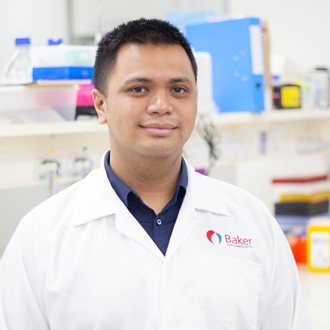
Dr Mark Louis Vidallon is a chemist and a colloid scientist in the Molecular Imaging and Nanotherapeutics laboratory. Using his expertise in colloid design and characterisation, Dr Vidallon is currently fabricating next-generation mRNA nanotherapeutics, personalisable colloidal theranostic materials, and cell membrane-biointerfaced systems for cardiovascular diseases.
Dr Vidallon completed his PhD in Chemistry in March 2022 at Monash University. His PhD research focused on the development of novel types of gas-containing and gas-generating colloids (nanoparticles, bubbles, and emulsion nanodroplets), based on red blood cell membranes and bioinspired polydopamine, for ultrasound and photoacoustic imaging, drug delivery, and theranostic applications. He specialised in the physicochemical characterisation of these multistimuli-responsive and unstable colloidal materials using advanced instrumentation, mainly electron microscopy, small- and ultra-small-angle neutron scattering, and atomic force microscopy.
Dr Vidallon holds an honorary appointment at the Baker Department of Cardiometabolic Health, University of Melbourne, an adjunct lecturer appointment at Baker Department of Cardiovascular Research, Translation and Implementation, La Trobe University, and an affiliate position at the School of Chemistry, Monash University.
Achievements
- National Heart Foundation Vanguard Grants (2025–2026)
- National Health and Medical Research Council Ideas Grants (2025–2028)
- National Heart Foundation Vanguard Grants (2024–2025)
- Sir Edward Dunlop Medical Research Foundation Grant (2024–2025)
- National Heart Foundation Postdoctoral Fellow and Paul Korner Innovation Award (2024–2025)
- CASS Foundation Medicine/Science Grant (2024)
Awards
- Evan Unger Award, World Molecular Imaging Congress (2024)
- Finalist, Premier’s Awards for Health and Medical Research, Basic Science Researcher Award (2023–2024)
- Mollie Holman Award, Faculty of Science, Monash University (2023)
- Winner, Royal Society of Victoria Young Scientist Research Prize (2021)