
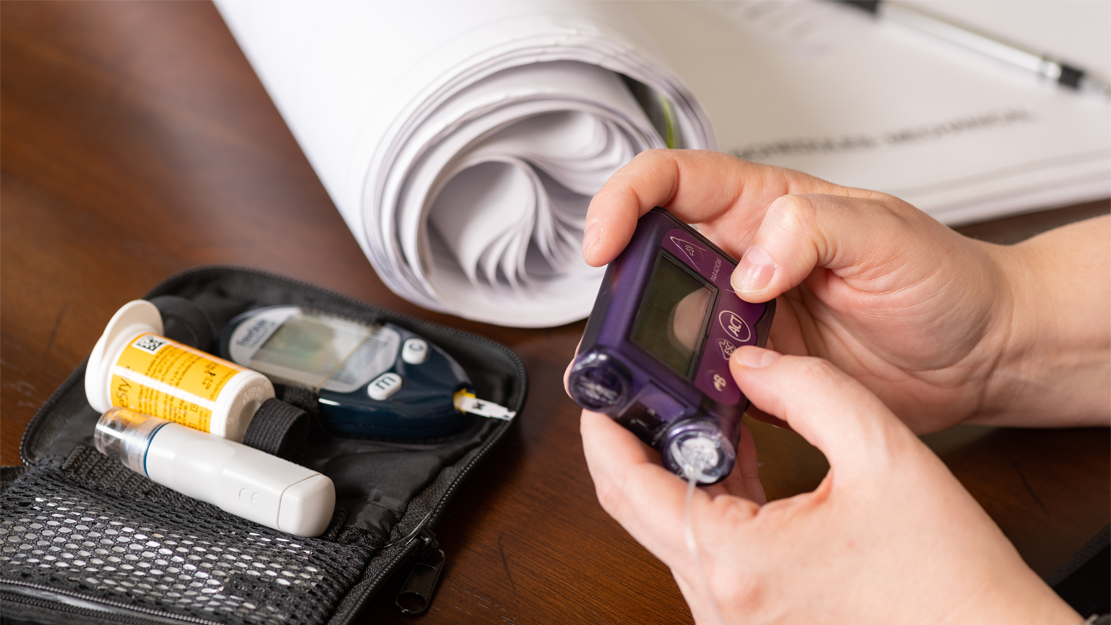
Most pump issues can be quickly identified and resolved through systematic troubleshooting. Understanding how to work through common problems and knowing when to contact your pump company can help you maintain safe blood glucose management.
This guide provides a comprehensive troubleshooting checklist and clear instructions for managing pump malfunctions, including how to safely return to insulin pen injections if needed.
What you will learn in this fact sheet
This fact sheet provides essential troubleshooting information for insulin pump users.
- Systematic troubleshooting checklist to identify common issues.
- When and how to report pump malfunctions.
- How to calculate insulin doses when returning to pen injections.
- Contact information for major pump companies.
Important safety reminder
Always manage your high blood glucose levels first (as per the Managing Hyperglycaemia and/or Sick Days on an Insulin Pump fact sheet) before proceeding with troubleshooting.
Troubleshooting checklist
Work through these questions systematically to identify if the problem can be resolved.
Infusion set issues:
- Did you change the infusion set in the past 2 hours?
- Is blood glucose going up after you inserted the new infusion set?
- Do you think the cannula could be kinked?
- Is your infusion set connected to the insulin cartridge?
- Check tubing for air bubbles.
- Has your set been changed within the last 72 hours?
- Is your insertion site red, sore or swollen?
Insulin delivery issues:
- Can you see or smell insulin leaking?
- Can you feel moisture on the pump casing or at the insertion site?
- Did you take your last bolus? Was it actually delivered?
- If you recently changed your set, did you fill the cannula?
- Is your insulin in date and been appropriately stored?
Pump settings:
- Are you in the correct basal program?
- Is the date and time on your pump correct?
If you identify a pump issue that can be resolved, address this and continue on your pump.
Pump malfunction
If you've worked through the troubleshooting checklist and believe your pump has malfunctioned:
Step 1: Manage hyperglycaemia first
Follow the guidelines in the Managing Hyperglycaemia and/or Sick Days on an Insulin Pump fact sheet before proceeding.
Step 2: Contact your pump company
Report the malfunction to your pump company:
- Medtronic: 1800 777 808
- AMSL: 1300 851 056
- Roche: (02) 9860 2100
- Ypsomed: 1800 447 042
- Omnipod: 1800 954 074
Step 3: Arrange replacement
If you've had a new pump within the last 4 years, the company will generally arrange a replacement pump within 24–48 hours.
You may require assistance from a diabetes educator or endocrinologist to add your settings into your replacement pump. Always keep a copy of your current rates and ratios in case of malfunction.
Important note: If you've returned to insulin pen injections including basal (long-acting) insulin, you'll need to allow for this long-acting insulin when reconnecting to your pump.
Speak to your physician or diabetes educator about this.
Supporting vital diabetes research
This evidence-based fact sheet was developed by the Baker Heart and Diabetes Institute, where our team provides specialist diabetes education and insulin pump services.
Help us continue providing free, expert health resources. Your support enables us to develop more comprehensive fact sheets for diabetes management, conduct research that improves outcomes for people with type 1 diabetes, and make evidence-based health information freely accessible to all Australians.
Returning to insulin pen injections
You should always have a current prescription of your previous basal (long-acting) insulin.
Calculating your insulin doses
Step 1: Find your Total Daily Dose
Refer to your pump's Total Daily Dose. You can find this on your pump (Daily Totals or history menu), on a previous download, or on your supporting software (app).
Step 2: Divide by 2
Divide your pump total daily dose into 2.
- Basal insulin (first half):
One half is your basal insulin and can be given as a single dose OR as a split dose (½ in morning and ½ at night). - Bolus insulin (second half):
The other half is your bolus insulin for meals and corrections.
Continue to carbohydrate count and use your insulin-to-carbohydrate ratio (ICR) for meals and insulin sensitivity factor (ISF) to correct high blood glucose levels.
OR
If this is not possible, simply divide this half into 3 doses (breakfast, lunch and dinner) and take before meals.
Example calculation
Total Daily Dose = 48 units
Divide by 2 = 24 units
This means:
- 24 units of basal insulin (Optisulin/Glargine, Toujeo, Levemir)
- 24 units of bolus insulin (Novorapid, Humalog, Apidra or Fiasp).
Bolus insulin can be taken as:
- 8 units per meal (24 divided by 3 = 8 units).
OR - Use your insulin-to-carb ratio and insulin sensitivity factor.
Download your free fact sheet
Need personalised advice?
For individual guidance on insulin pump troubleshooting or returning to pen injections, contact the Baker Institute's insulin pump service.