
Laboratory
Haematopoiesis and Leukocyte Biology
ARC DECRA Fellow
Honorary National Heart Foundation Postdoctoral Fellow
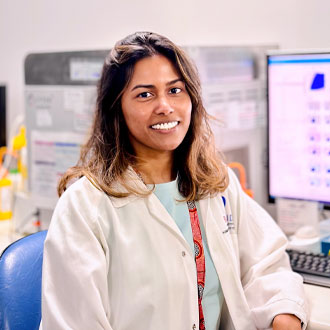
Pooranee is a postdoctoral researcher in the Haematopoiesis and Leukocyte Biology laboratory. Pooranee’s current focus is identifying and developing potential therapeutic applications to alter immune cellular sensitivity to ferroptosis, a form of cell death mechanism. She uses a number of approaches to address this topic, these include in vitro and in vivo animal models with dietary interventions, flow cytometry and mass-spectrometry based lipidomics (in collaboration with Professor Peter Meikle, also at the Baker Institute). Pooranee also aims to advance fundamental cell biology by determining why immune cells have unique lipidomes and why some cells are resistant, yet others are more sensitive to ferroptotic cell death.
Previously, Pooranee completed a Bachelor of Biomedicine at the University of Melbourne in 2017 where she majored in neuroscience. Following this, she completed an Honours year (2018) at La Trobe University with her current laboratory. In 2019, Pooranee started her PhD and was awarded a prestigious joint La Trobe University–Baker Institute Scholarship. Under the supervision of Dr Graeme Lancaster and Professor Andrew Murphy, she explored how differences in lipid composition alters the susceptibility of immune cells to ferroptosis and completed her PhD in Nov 2022.
Achievements
- ARC Discovery Early Career Researcher Award (2026–2029)
- University of Melbourne Establishment Grant (2026–2028)
- National Heart Foundation Postdoctoral Fellowship (2026–2027)
- The University of Melbourne Early Career Research Grant (2025)
- Jack Brockhoff Foundation Early Career Research Grant (2023–2025)
- La Trobe SABE HDR Research Funding (2022)
- Baker Institute Julie Campbell Award (2022)