
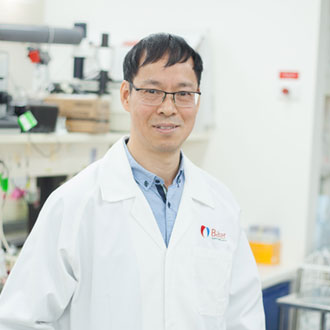

Meet the team



About the Biomarker Discovery laboratory
The Biomarker Discovery laboratory is transforming how we detect, monitor and treat cardiovascular disease through the development of cutting-edge biomarker analytical assays and discovery programs.
We provide both the facility and expertise to analyse known biomarkers, and the opportunity to discover and develop novel biomarkers that are clinically useful for diagnosing disease, predicting outcomes, and monitoring how patients respond to treatment.
Our work goes beyond biomarker discovery — we study the fundamental mechanisms of disease progression and therapeutic responses. Our academic research centres on cardiovascular pharmacology, heart failure, cardiorenal syndrome, and the identification of novel therapeutic targets for drug discovery and development.
From bench to bedside
We are a highly capable team whose research spans the entire translational pipeline — from cells to animals to human clinical trials. This bench-to-bedside approach has proven remarkably productive, generating numerous high-impact publications and patents. Since 2005, our work has been instrumental in securing multiple NHMRC Program Grants, including funding from 2016–2020, with ongoing success in competitive grant funding.
Research capabilities
Our laboratory offers extensive capabilities in preclinical studies and drug discovery, including:
- Cell and molecular biology.
- Protein biochemistry.
- Drug design and development.
- Pharmacology.
- Biomarker discovery.
- In vivo animal models for cardiac and renal disease studies.
In vitro expertise
We maintain primary cultures of cardiac myocytes and cardiac fibroblasts, vascular cells, kidney cells, blood cells and cell lines. These cultures support a broad range of preclinical studies, including early-phase pharmacological and drug discovery studies, drug target discovery, cellular efficacy validation and cellular toxicity studies.
In vivo capabilities
Our preclinical efficacy studies are built on several well-established, routinely performed animal models for both cardiac and renal diseases. We are well-equipped with strong expertise in analysing cardiac function (echocardiography, haemodynamic and pressure-volume loop analysis) and renal function (direct glomerular filtration rate measurement), as well as comprehensive post-tissue processing.
Clinical translation and collaboration
We currently conduct assays supporting several Baker Institute clinical trials, ensuring our laboratory discoveries directly inform patient care.
We also collaborate extensively with external institutions on biomarker assays, strengthening the impact and reach of our research.